
Introduction: When the “Future” Enters Your Shoe Cabinet
If 3D printed shoes before 2020 were expensive “window exhibits,” then 2025 is undoubtedly the “iPhone Moment” for this technology. Looking back from 2025, we have witnessed an astonishing leap of 3D printed footwear from laboratory concepts to mass consumer products. Once “geek toys” costing upwards of $500, they have now become daily staples for street fashion enthusiasts, serious runners, and environmentalists alike.
For consumers, the choice is no longer “whether to try it,” but “which one fits my lifestyle.” This guide combines the latest global market data and technical reviews to curate the innovative 3D printed shoe brands most worth buying in 2025, helping you understand the revolution happening under your feet.
Market Overview: The Shift from “Concept” to “Mass Production”
The Market Landscape in 2025
According to industry data, the global 3D printed footwear market has surpassed the $4.2 billion mark in 2025, with a compound annual growth rate (CAGR) as high as 25%. The driving force behind this explosive growth is not mere marketing hype, but fundamental breakthroughs in manufacturing technology.
- Price Drop: With the maturation of ARKKY‘s AIHALS and Adidas‘ Carbon DLS technologies, production efficiency has increased tenfold, pulling the average selling price down to the mass-market acceptable range of $150 – $250.
- Style Diversification: The market is no longer monopolized by “performance running shoes.” From PUMA‘s high-street fashion to Zellerfeld‘s designer slides, 3D printing is taking over every scenario from runways to rock walls.
Key Brands
In 2025, the following 5 brands represent the highest standards in the industry, each occupying a distinct ecological niche.
2.1 ARKKY: The Mass Market Disruptor & Street Aesthetic
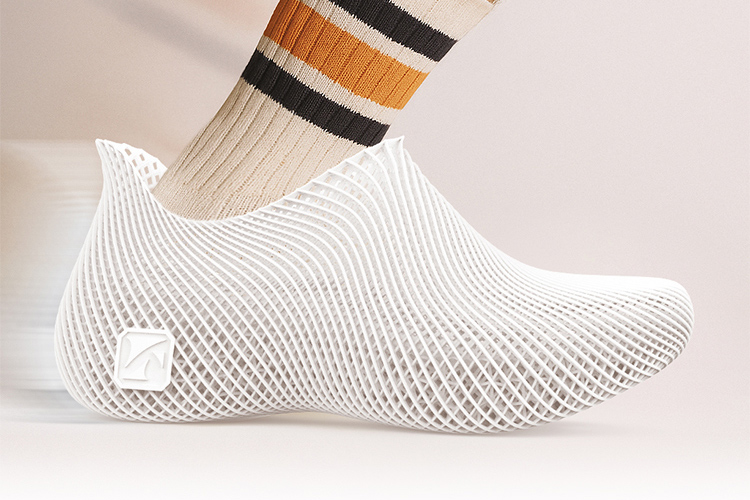
If Adidas is the evangelist of this technology, then ARKKY is the disruptor bringing it to ordinary households. In 2025, this brand has exploded in popularity due to its “High Cost-Performance Ratio” and “Street Aesthetics.”
- Core Tech: AIHALS ARKKY’s ace is its proprietary AIHALS (Artificial Intelligence Hindered Asynchronous Light Synthesis) technology. This tech boosts printing speed to dozens of times that of traditional SLA processes, achieving true mass production. This means consumers no longer pay for long lead times, and stock availability has drastically improved.
- Material Revolution: Bio-based TPU ARKKY abandoned the “brittle and hard” shortcomings of early photosensitive resins, adopting modified Bio-based TPU. This material boasts an elongation at break of over 650% and tensile strength exceeding 1500%, offering a touch close to high-performance rubber but lighter and bouncier.
- Signature Models:
- CozLite: Designed for daily commuting, famous for its soft, “walking on clouds” feel. The top choice for beginners.
- AeroDash: Features an aggressive streamlined look with exposed complex lattice structures. It perfectly fits the Techwear aesthetic and is hailed as “affordable haute couture”.
Adidas 4D: The Proven Performance Standard
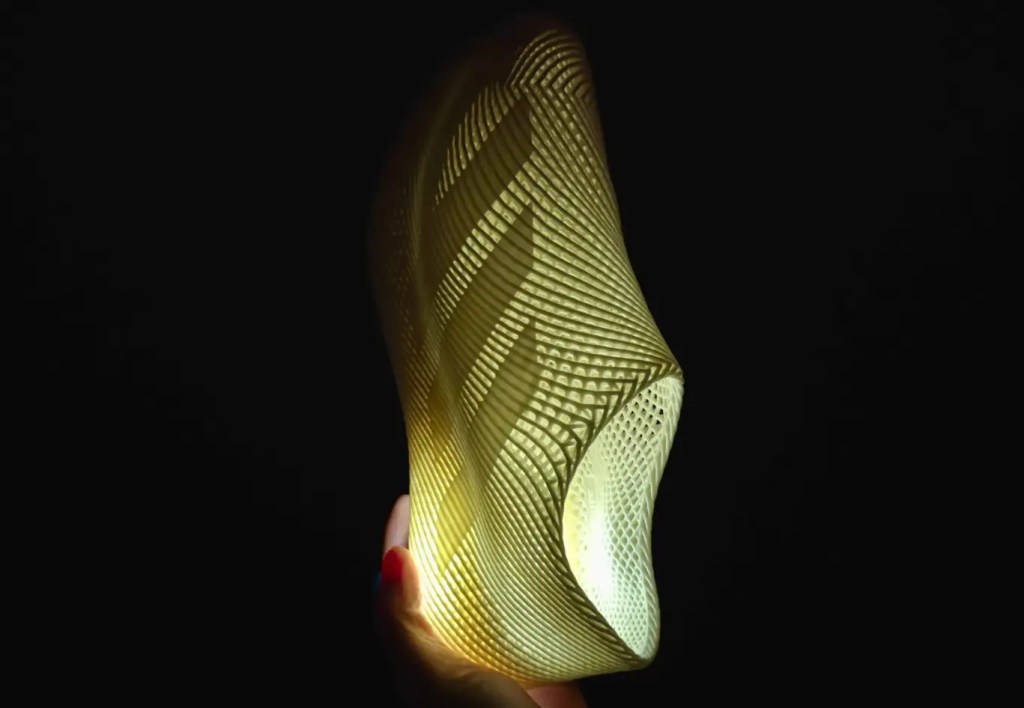
As the giant that bet on 3D printing earliest, Adidas 4D remains the most trusted choice for serious runners in 2025.
- Core Tech: Carbon DLS™ Adidas continues to deepen its collaboration with Carbon, utilizing Digital Light Synthesis technology to manufacture midsoles. Its advantage lies in extreme consistency and data accumulation from millions of kilometers of road testing.
- Performance Focus: 4DFWD Its flagship 4DFWD series uses a special “Bowtie” lattice structure that converts the vertical pressure of a runner’s landing into forward propulsion. This “mechanical assistance” is physically impossible to achieve with traditional foam materials.
- Buying Advice: If you seek ultimate athletic performance and brand reliability, Adidas 4D remains the industry benchmark.
PUMA x A$AP Rocky: The Pinnacle of Avant-Garde Visuals
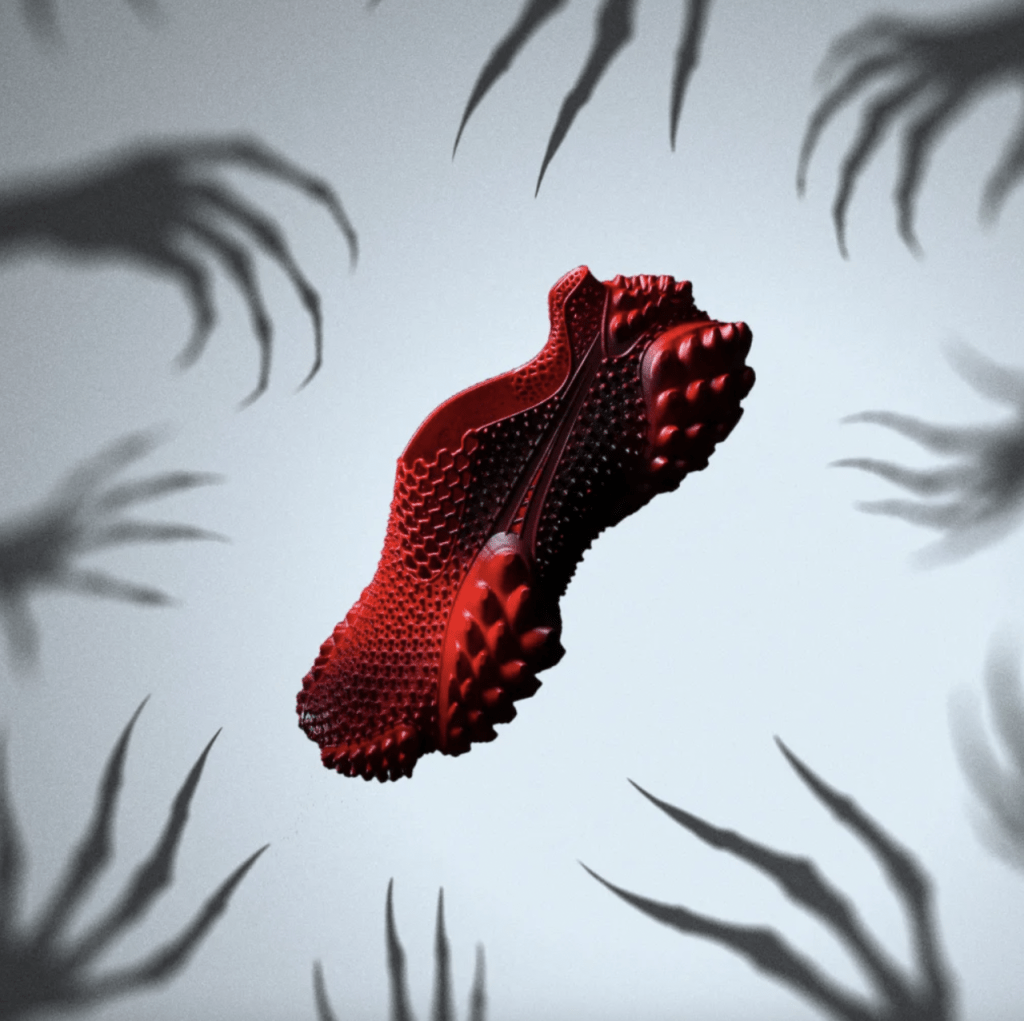
When 3D printing meets a hip-hop superstar, the result is the PUMA Mostro 3.D.
- Visual Impact This shoe completely subverts traditional sneaker silhouettes. The body is covered in spike-like structures generated by resin 3D printing, presenting an “alien creature” visual. It is not just a shoe, but a modern sculpture worn on the feet.
- Market Positioning Priced around $250, but often hard to find. It is the darling of High Street Fashion in 2025, designed by A$AP Rocky himself, focusing on scarcity and head-turning rates.
- Buying Advice: Suitable for players with ample budget who pursue extreme individuality and trend topics.
Zellerfeld: The Custom Platform Revolution
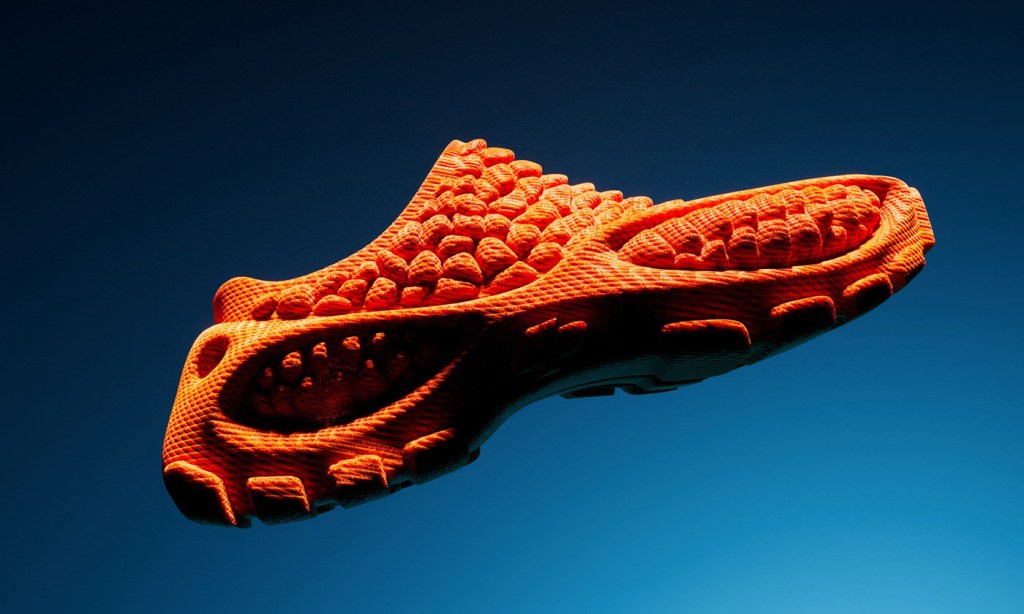
Zellerfeld is not a traditional shoe factory; it is more like an “App Store.” It provides a 3D printing platform for major brands like Heron Preston and Louis Vuitton, as well as independent designers.
- Core Model: Scan-to-Print Users simply scan their feet via smartphone, and Zellerfeld prints a pair of shoes that fit 100% perfectly. This “custom-fit” model completely solves issues of chafing and incorrect sizing.
- Circular Concept Zellerfeld’s shoes are typically printed from a single material, with no glue or stitching. Once worn out, they can be sent back to be melted down and printed into new shoes, achieving true 100% recyclability.
- Buying Advice: Ideal for eco-pioneers, people with hard-to-fit feet (wide/high instep), and consumers who love trying independent designer works.
2.5 HILOS: The Engine Behind On-Demand Manufacturing
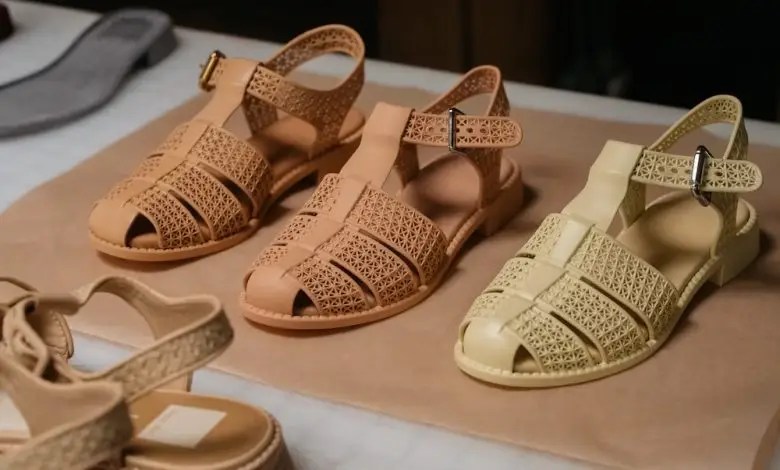
You might not have heard of HILOS, but the 3D printed shoes launched by fashion brands you like (such as Dolce Vita, Steve Madden) are likely manufactured by HILOS.
- Business Model HILOS focuses on providing On-Demand supply chains for traditional fashion brands. This means brands don’t need to open molds or stockpile inventory; printing starts only after a user places an order.
- Eco-Performance Data shows HILOS’s model can reduce carbon emissions by 48% and water waste by 99%.
- Buying Advice: If you are looking for sandals or mules from mainstream fashion brands like Dolce Vita but want the tech feel and eco-attributes of 3D printing, look for products powered by HILOS technology.
3. Hardcore Tech Breakdown: Lattice Structure vs. Traditional Foam
Why should you ditch traditional EVA running shoes for 3D printed ones in 2025? The core lies in the dimensional superiority of Lattice Structure over Foam.
| Dimension | Traditional EVA Sneakers | 3D Printed Shoes (TPU Lattice) | 2025 Core Advantage Analysis |
|---|---|---|---|
| Breathability | Passive Cooling: Relies on mesh, heat trapped underfoot. | Active Airflow: Hollow sole forms an “air tunnel,” actively pumping out heat with every step. | Goodbye “burning feet,” the ultimate summer commuter gear. |
| Rebound Life | Gradual Decay: Foam cells burst after 300km, feeling hard and flat. | Constant Rebound: Mechanical structure stores energy; almost no decay after millions of steps. | The feel remains consistent from day one to year two. |
| Support Logic | Uniform Material: Sole hardness is consistent throughout. | Zoned Programming: Algorithms adjust lattice density—hard heel, bouncy toe—without splicing. | True “Personalized” Ergonomics. |
| Durability | Glued Assembly: Prone to sole separation. | One-Piece: No glue, no stitching, physically robust structure. | Hard to “wear out,” usually replaced only for style updates. |
4. 2025 3D Printed Shoe Buying Guide
Faced with a dazzling array of brands, how do you choose? We have organized the following decision matrix for you:
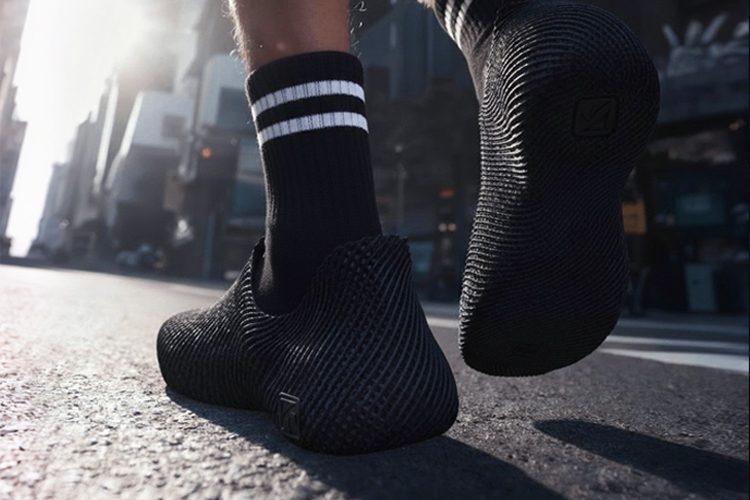
Scenario 1: Daily Commute & City Walking
- Top Pick: ARKKY
- Reason: The CozLite series offers excellent comfort and breathability at a very high cost-performance ratio (around $150). Its bio-based TPU material is stain-resistant and easy to clean.
- Keywords: Comfort, Value, Breathable.
Scenario 2: Serious Running & Training
- Top Pick: Adidas 4D
- Reason: The 4DFWD propulsion technology is professionally verified, suitable for daily 5-10km runs. The major brand quality control and after-sales network are also pluses.
- Keywords: Propulsion, Stability, Professional.
Scenario 3: Niche Outdoor & Climbing
- Top Pick: ATHOS
- Reason: Irreplaceable customized fit, a must-have for those who need to climb high without the pain.
- Keywords: Custom, Extreme Fit.
Scenario 4: Street Fashion & Hype
- Top Pick: PUMA x A$AP Rocky or ARKKY (AeroDash)
- Reason: If you have the budget and luck, PUMA’s spike design is the king of attention. If you seek “affordable techwear,” ARKKY’s AeroDash paired with cargo pants creates a strong Cyberpunk vibe.
- Keywords: Visual Impact, Head-Turner, Topic Piece.
Scenario 5: Minimalism & Eco-Conscious
- Top Pick: Zellerfeld or HILOS
- Reason: The fully circular recycling model hits the eco-pain point directly. Zellerfeld’s glue-free design and mono-material aesthetic are perfect for minimalists.
- Keywords: Recyclable, Zero Waste, Custom.
5. Conclusion: Engineering Aesthetics Underfoot
In 2025, 3D printed shoes are no longer a distant future, but a tangible reality.
From ARKKY‘s mass production breakthrough to Adidas‘ performance refinement, and PUMA‘s aesthetic reshaping, these brands collectively prove one thing: the future of footwear belongs to “Engineering Aesthetics.” We are bidding farewell to uniform glue and foam, welcoming a new era of Visible Structure, Data-Driven Design, and On-Demand Manufacturing.
Now, it is time to throw away those stuffy, collapsed old sneakers and slip into a future woven by algorithms and lasers. Whether for a more comfortable step or that stunning glance on the street, 3D printed shoes deserve to be the protagonist in your shoe cabinet in 2025.
 FlexCreate